What Does Hail Damage Look Like on a Roof in Raleigh, NC?
What does hail damage look like on a roof? On asphalt shingles, look for dark, randomly scattered spots where granules are missing, often with a soft, bruised feel. The damage is easy to miss from the ground in Raleigh, and it can look a lot like ordinary aging on the 20-to-25-year-old roofs now common in Wakefield and across North Raleigh. This guide covers what to look for on each roof type, what isn't hail, how big hail has to be, and what Raleigh homeowners should do first after a storm.
What Does Hail Damage Look Like on Asphalt Shingles?
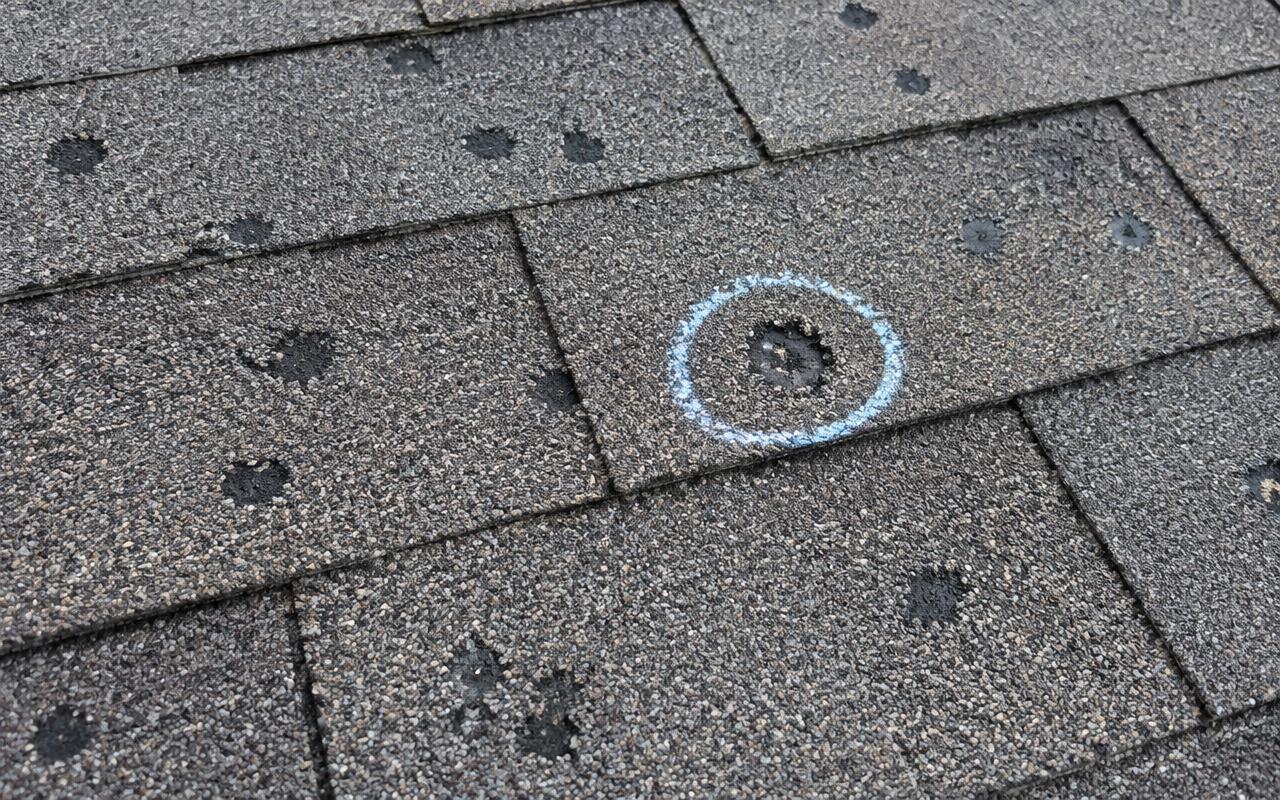
Hail damage on asphalt shingles looks like random dark spots or divots with missing granules. Fresh strikes may look black or slightly shiny, and they can feel soft when pressed, like a bruise on an apple. The exposed mat or felt underneath is what matters.
Here's what Travelers and Progressive tell homeowners to look for, and what we check on a Raleigh roof:
- Random pattern. Hail doesn't fall in neat lines. Strikes are scattered, with no clear pattern.
- Missing granules. Dark patches show where the protective granules were knocked off.
- Granules in the gutters. Extra loose granules can collect at the downspouts after a storm.
- Soft spots. A bruised area gives slightly under the finger, where sound shingle feels firm.
- Strikes on the soft metals. Dings on vents, gutters and flashing show that hail hit the house, and they can point to its direction and size.
Wind direction matters, so strikes may be heavier on one slope than another. This kind of damage rarely causes a leak the same day. On a storm-damaged roof in Raleigh, the larger concern is lost granules, which can shorten the service life of the shingles.
Hail Damage on Metal, Wood and Other Raleigh Roof Types
Raleigh's roofs aren't all asphalt, especially in older neighborhoods and on higher-end North Raleigh homes. Hail leaves different marks on different materials.
| Roof material | What hail damage looks like | What we also check |
|---|---|---|
| Standing seam or exposed-fastener metal | Dents or depressions, plus chipped paint or coating | Seams, loose fasteners and any bare spots that could rust |
| Cedar shake or wood shingle | Fresh splits with sharp corners, brown or orange in color, and little weathering along the edges | Bruises or scars on the surface |
| Slate or tile, including synthetic | Chips, punctures, cracks or dents | Granule loss on coated products, and leaks under cracked pieces |
| Skylights, vents and caps | Cracks, dents or broken housings | Valleys and eaves, where hail can collect |
A dented metal roof may still keep water out. A dent that breaks the coating or opens a seam is a different problem, and policies can treat those differently, so check your coverage. On wood, age matters as well: old splits have weathered, dull edges, while fresh ones look sharp and clean.
What Isn't Hail: Common Look-Alikes on Raleigh Roofs
Plenty of roof problems get mistaken for hail, especially on an older roof. Travelers lists blistering, cracking, flaking, general granule loss, algae and manufacturing defects as common look-alikes. Here's how we tell them apart.
| What you see | More likely | How it differs from hail |
|---|---|---|
| Small pits with sharp edges and no bruise | Blistering | The mat feels firm and pits often follow sun-exposed slopes |
| Even granule thinning across the roof | Normal aging | No distinct strike marks, and more wear on the sunniest slopes |
| Horizontal crease near the top of a shingle | Wind damage | A fold line from a lifted tab, not an impact |
| Dark streaks running down the slope | Algae | A stain, with granules still in place |
| Gouges or scrapes under a big limb | Tree contact | Marks cluster near branches instead of scattering across the slope |
| Scuffs in a walking path | Foot traffic | Marks follow a route rather than a random scatter |
Algae and tree contact come up often here. Raleigh gets about 46 inches of rain a year, summers are humid, and the city says tree canopy accounts for 50.5% of its land cover. A shaded roof in Hayes Barton or off Six Forks Road can show streaks and limb marks that have nothing to do with hail.
How Big Does Hail Have to Be to Damage a Roof?
Roughly 1 inch is where the risk starts for asphalt shingles, with heavier shingles usually holding up to larger stones. Quarter-size hail, at 1 inch, is also where the National Weather Service considers hail severe. It's the size reported around Raleigh on May 5, 2025. Size is only part of the answer, because age and condition change the result.
Older research from Haag Engineering found that 3/4-inch hail damaged deteriorated, unsupported shingles, 1-inch hail damaged lightweight shingles and 1 1/4-inch hail damaged heavy composition shingles. Other engineers place the threshold higher, closer to 1 1/2 to 2 inches on a quality roof in good condition.
Smaller hail may matter more than people once thought. A 2025 study from the Insurance Institute for Business and Home Safety found that hail under 1 inch can speed up the aging of asphalt shingles. Weathered shingles hit by that smaller hail were about ten times more susceptible to damage from a later severe hailstorm.
Hail and Storm Damage in Raleigh, NC
Hail in Raleigh is mostly a spring event, and it's patchy. One tracker built on NOAA Storm Prediction Center data lists 121 hail reports for the Raleigh area since 2004, and 53 of them came in May. It shows none within 10 miles of the city so far in 2026.
May 5, 2025 is a good local example. Quarter-size hail was reported about 2.5 miles south of Raleigh near US-401 and I-40, then again along I-540 between Capital Boulevard and US-64. Those reports came from specific spots, so a roof in Wakefield or Five Points could have had a very different afternoon.
Wind and trees are often the bigger threat here. Trees came down in Wake County in the March 16, 2026 storms, and a July 9, 2026 report put a tree across Apache Drive in Raleigh. Long-time residents remember Hurricane Fran in 1996, when one Harden Road homeowner near Rex Hospital lost 37 trees. A roof can have both hail and wind damage, and they don't always come from the same storm.
Roof age raises the stakes. Much of Wakefield Plantation dates to the late 1990s and early 2000s, so original or early roofs there have had years of weathering, which is exactly what the IBHS research flags as a risk. Older homes around Five Points may have newer roofs, but they often have more flashing and chimney work to check. Our Raleigh roofing company sees both. If a neighbor's roofer found damage on your street, that's a reason to get yours checked. It doesn't prove your roof was hit.
Think hail may have hit your Raleigh roof? Call Pro Performance Roofing at (919) 241-7663 or schedule a free storm damage inspection in Raleigh. We get on the roof when it's safe to do so, document what we find and show you the photos.
What Raleigh Homeowners Should Do After a Hailstorm
Stay off the roof. Hail damage is hard to read from a ladder, and a wet or steep roof is dangerous. Follow these steps. The documentation, temporary repair and claim guidance comes from the North Carolina Department of Insurance.
- Photograph from the ground. Capture gutters, downspouts, siding, window screens and anything dented, with the date of the storm.
- Stop active leaks. Reasonable temporary repairs, like tarping, may be reimbursed, so keep your receipts and take photos first.
- Get a roof inspection in Raleigh. We evaluate the whole roof, explain what we find in plain language and tell you if it isn't hail.
- Read your deductible. North Carolina wind and hail deductibles may be a percentage of your dwelling coverage. At 1% on $500,000 of coverage, you'd pay $5,000. A named storm deductible of 2% would be $10,000.
- Report the loss to your insurer. Wait on permanent repairs until the insurer has inspected and you've agreed on costs.
That order isn't a legal requirement, and many homeowners call the carrier first. We just think it helps to know what's on the roof, and how your deductible compares to the damage, before you open a claim. The department also notes that insurers generally pay to replace only the damaged area, even if the new shingles won't match.
Our production manager, Brandon Kessler, has worked as a property adjuster and third-party inspector as well as a roofer, so we know what a carrier needs to see. Our article on the roof insurance claim process covers what happens next, including first and second payments. Your policy and your carrier decide coverage. Our role is to document the damage and act as a technical advisor.
Repair or Replace After Hail in Raleigh?
It depends on how much damage there is, how old the roof is and what your carrier approves. A few strikes on a young roof in Brier Creek may only need a targeted fix, and we'll say so. We complete more repairs than replacements for that reason.
A roof with widespread strikes across several slopes, or an aging Wakefield roof that has lost its granule protection, is a different conversation. If your claim doesn't cover the whole job, it helps to know how much a new roof costs in Raleigh before you decide. When residential roof replacement is the right call, it's also the moment to think about the next storm. Our guide to shingle grades covers upgraded options, including Class 4 impact-resistant shingles on qualifying products.
Be realistic about what impact resistance buys you. The IBHS study found that impact-resistant shingles performed only slightly better than conventional shingles for cumulative granule loss from small hail. They're a good upgrade, but they don't make a roof hail-proof.
Frequently Asked Questions
Is it worth going through insurance for hail damage on a Raleigh roof?
It depends on how the repair or replacement cost compares with your deductible. In North Carolina, that deductible can be a percentage of your dwelling coverage, so it may be larger than you expect. Get the damage documented first, then compare the numbers and talk to your agent.
Can insurance adjusters tell how old hail damage is?
They can often get a good idea from weathering. Fresh strikes tend to look darker and sharper, while older ones fade as exposed asphalt ages. Storm dates and weather reports help too. That's why it's worth having a Raleigh roof checked soon after a storm.
When does it hail in Raleigh?
Mostly in spring. A tracker of NOAA reports for the Raleigh area shows May as the clear peak, with March and April also active. Reports drop off after August, and it lists none from October through December. Summer thunderstorms can still bring hail.
Does hail damage always cause a roof leak?
No. Most hail damage doesn't leak right away. It takes away granules that protect the shingle, so the roof can age faster and fail sooner. A lack of ceiling stains in your Raleigh home doesn't mean your roof came through the storm unharmed.
How soon should I report hail damage in North Carolina?
Report it promptly, and check your policy for its own deadlines. Delays can make it harder to connect the damage to a specific storm. The North Carolina Department of Insurance also expects you to take reasonable steps to prevent further damage while you wait.
The Bottom Line
So what does hail damage look like on a roof? Random dark bruises, missing granules and dented soft metals, with a scatter pattern that normal aging doesn't produce. In Raleigh, where hail is patchy and many roofs are 20 to 25 years old, a photo from the ground rarely settles the question.
Call Pro Performance Roofing at (919) 241-7663 or request a free storm damage inspection. Inspections for insurance claims are free. We're locally owned and based on Honeycutt Road in North Raleigh, working with homeowners from Wakefield and Six Forks to Five Points and across Wake County. We'll tell you what's up there, including when it isn't hail.